
Most training programmes share the same gap. The content is good. The delivery is professional. But when a rep, clinician, or manager faces the real moment — the difficult customer, the high stakes decision, the conversation they've been dreading — what they learned on a slide deck offers very little help.
That gap exists because knowledge and performance are two different things. Knowledge comes from understanding. Performance comes from practice. And the benefits of AI roleplay training are most clearly seen in the teams that have closed that gap — replacing passive learning with realistic, repeated practice that builds the confidence and capability to perform when it counts.
Here is which teams gain the most, and what the evidence shows.
Your Learning Path
- Why AI roleplay training works across teams and industries
- How sales teams use AI roleplay to sharpen performance and close more deals
- How customer service teams build consistency and composure through AI training
- How healthcare teams use AI roleplay to prepare for high stakes patient interactions
- Which other teams benefit from training with AI
- How to get started with AI roleplay training in your organisation
Why AI Roleplay Training Works Across Teams
The common thread across every team that benefits from AI roleplay training is straightforward: their performance depends on human interaction, and human interaction cannot be learned from a slide deck.
The skills that matter most in any customer-facing, clinical, or leadership role — composure under pressure, confident communication, sound judgement in difficult moments — only develop through experience. The problem is that traditional training rarely provides enough of it. Live role plays are infrequent, inconsistent, and limited by trainer availability. Real world practice means real world consequences.
AI roleplay training changes that equation. It gives every employee access to realistic, on demand practice scenarios powered by AI virtual humans that respond and adapt the way real people do. Learners build confidence, sharpen judgement, and develop the communication skills that classroom training alone cannot produce.
The evidence backs this up. In a military recruiting programme, platform usage explained 84.7% of the variance in how recruits performed in their real assessed skills lab. In a healthcare deployment, in-person simulation cost $130 per learner — AI roleplay on Virti's platform cost $11.29, a 91% reduction with no drop in educational quality. In a global sales pilot, reps voluntarily completed an average of 32.5 practice sessions each, with average scores improving from 56.2% on first attempt to 66.8% on best attempt.
Any team where people need to perform under pressure, navigate difficult conversations, or make high stakes decisions in real time is a team that benefits from AI roleplay training.
Sales Teams
For sales teams, the difference between a good rep and a great one often comes down to what happens when a conversation gets hard. When a prospect pushes back on price, stalls on a decision, or raises an objection the rep hasn't heard before, that's the moment that wins or loses the deal.
AI roleplay training gives sales reps the repetitions they need to handle those moments with confidence. They practise objection handling, negotiation, cold calls, discovery calls, and closing scenarios on demand — facing a virtual prospect that responds dynamically, pushes back realistically, and doesn't follow a predictable script.
The benefits are measurable. Reps who practise consistently close more deals, shorten their sales cycles, and ramp up faster from onboarding. AI roleplay can reduce onboarding time from months to weeks for new hires stepping into a sales role. Rather than learning through lost deals, they arrive in real conversations having already faced the difficult ones dozens of times.
Customer Service Teams
Customer service is one of the highest pressure, highest volume environments in any organisation. Agents handle dozens of interactions every day — many with customers who are frustrated, impatient, or difficult to manage. The quality of those interactions determines whether customers stay or leave.
AI roleplay training gives customer service teams a way to practise the conversations that matter most before they face them live. De-escalation, empathy under pressure, handling complaints outside of policy, managing customers who refuse to be satisfied — all of it can be rehearsed in realistic scenarios that build the muscle memory agents need to stay composed when it counts.
The impact shows up in the metrics that matter most. First call resolution rates improve. Customer satisfaction scores increase. Escalation rates fall. In comparable contact centre deployments, organisations using AI roleplay have seen new agents reach competency 20 to 30% faster, with QA supervision hours per new agent dropping by up to 80%.
Healthcare Teams
In healthcare, the stakes of a poorly handled interaction are higher than in almost any other environment. A clinician who struggles to communicate a difficult diagnosis, a nurse who loses composure under pressure, a team that communicates poorly during a critical moment — these are not just performance issues. They are patient safety issues.
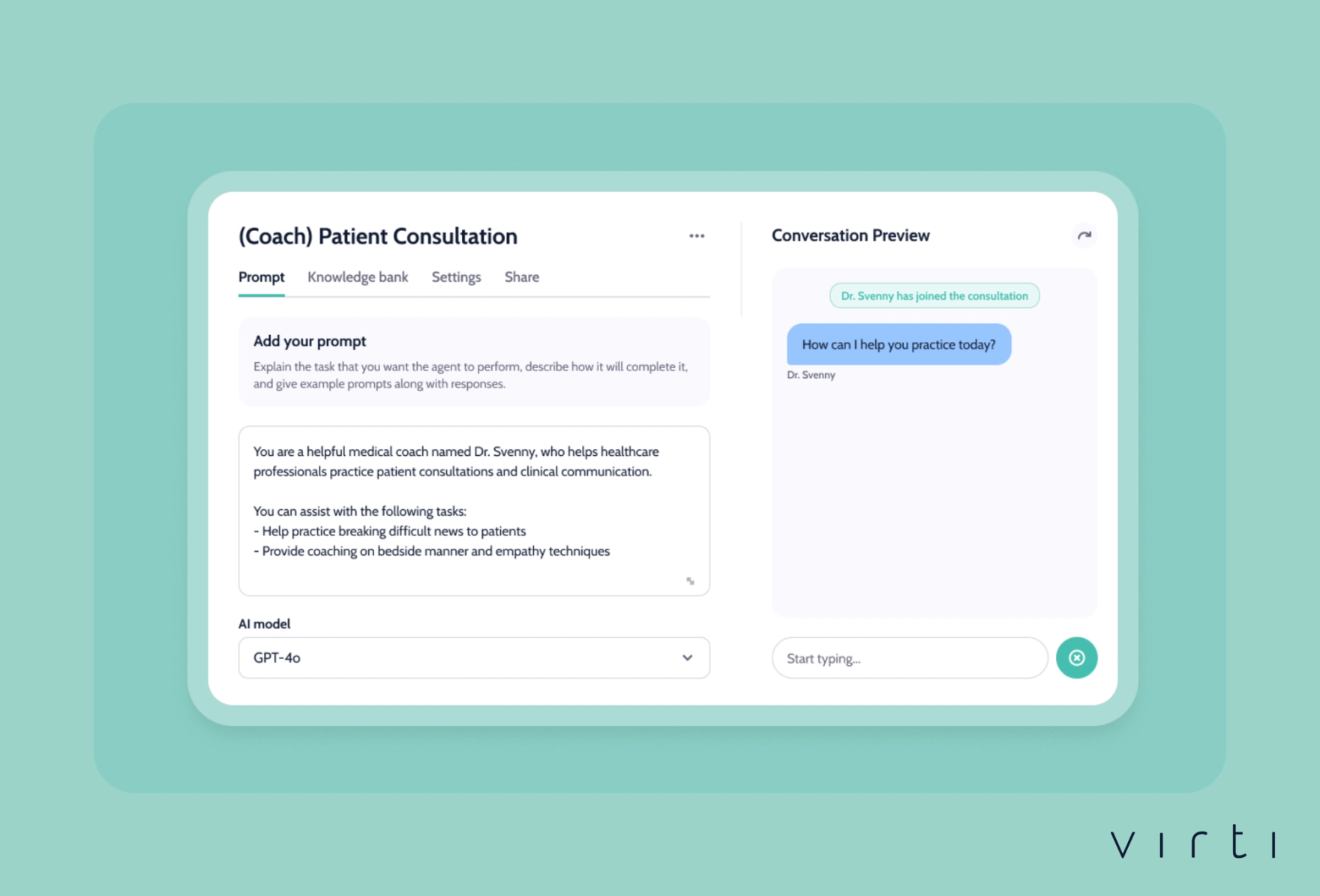
AI roleplay training gives healthcare teams a safe environment to practise exactly these scenarios. Clinicians can rehearse difficult patient conversations, practise breaking bad news, and work through high pressure decision making scenarios — all without any risk to real patients.
The evidence base for simulation in healthcare is stronger than in any other sector. A federal healthcare system comparing in-person simulation to AI roleplay on Virti's platform found a 91% cost reduction per learner, with no drop in educational quality. Thirty-nine clinical staff completed the training over thirty days without a single disruption to ward operations.
Repeated, realistic practice improves clinical confidence, reduces errors, and builds the communication skills that determine the quality of patient care. AI makes that practice more accessible, more consistent, and more scalable than ever before.
Other Teams That Benefit From AI Roleplay Training
Sales, customer service, and healthcare are the clearest use cases — but the benefits of AI roleplay training extend to any team where people need to perform under pressure, communicate clearly, and make sound judgements in real time.
HR and people teams use AI roleplay to practise performance reviews, difficult conversations, conflict resolution, and sensitive discussions — so that when those moments arrive, they're handled with confidence and consistency rather than anxiety and avoidance.
Leadership and management teams use simulation to practise the conversations that define culture — giving feedback, managing underperformance, navigating team conflict — in a safe environment before they happen in the real world. Every session generates behavioural data that makes leadership development measurable rather than assumed.
Finance and legal teams use AI roleplay to practise client communication, negotiation, and high stakes advisory conversations where tone and judgement matter as much as technical knowledge.
Retail and hospitality teams use simulation to build the service skills that drive customer loyalty — handling complaints, upselling naturally, and maintaining composure during busy, high pressure periods.
The common thread is this: wherever your people need to perform in the moment, AI roleplay training helps them get there faster — with the data to show it's working.
How to Get Started With AI Roleplay Training
Getting started with AI roleplay training does not require an overhaul of your existing programme. With Virti, you can build your first scenarios quickly — either from a simple prompt or by uploading your existing training materials, scripts, and frameworks so every simulation is grounded in your organisation's real content from day one.
Start with the team or scenario where the performance gap is most visible. A sales team missing quota. A customer service team with rising escalation rates. A clinical team preparing for a high pressure environment. Build a focused set of scenarios around the conversations that matter most, run them with a pilot group, and let the data show you where confidence is building and where gaps remain.
From there, Virti's AI powered virtual humans handle the practice — responding dynamically to each learner, delivering personalised feedback after every session, and generating the analytics that show managers exactly how their teams are developing over time. As your scenario library grows, so does your organisation's ability to train any team, anywhere, at any scale — without adding trainer time or disrupting daily operations.
Before You Go
- The core benefit of AI roleplay training is closing the gap between knowledge and performance — giving every employee realistic, repeated practice before the real moment arrives
- Sales teams use AI roleplay to build objection handling, negotiation, and closing confidence — with measurable improvements in close rates, sales cycle length, and onboarding speed
- Customer service teams use simulation to practise de-escalation, empathy, and complaint handling — reducing escalations, improving satisfaction scores, and cutting supervision hours
- Healthcare teams use AI roleplay to prepare for difficult patient interactions and high pressure clinical scenarios — with a 91% cost reduction per learner compared to in-person simulation and no drop in educational quality
- HR, leadership, finance, legal, and retail teams all benefit wherever communication and judgement under pressure matter
- With Virti, AI roleplay scenarios are built from your existing training content, with personalised feedback and analytics that make training impact visible and measurable
Frequently Asked Questions
What are the main benefits of AI roleplay training over traditional role play?
Traditional role play is limited by trainer availability, colleague willingness, and the inability to replicate genuine pressure. AI roleplay removes those constraints entirely. Practice is available on demand, scenarios respond dynamically to what each learner actually says, and every session generates specific, actionable feedback. The result is more practice, more realistic practice, and measurable improvement — at a fraction of the cost of in-person simulation.
How quickly do teams see the benefits of AI roleplay training?
Most teams see improvements in confidence within the first few weeks of consistent practice. Measurable improvements in performance metrics — conversion rates, first call resolution, clinical competency scores — typically emerge within one to three months, depending on how frequently learners are practising and which scenarios they are focusing on. The key is regularity: short, frequent sessions build skills faster than occasional long ones.
Can the benefits of AI roleplay training be measured?
Yes — and this is one of its most significant advantages over traditional training methods. Every Virti session generates data on learner performance, showing how confidence develops over time, where skill gaps persist, and which scenarios are driving the most improvement. These insights connect directly to the business outcomes that matter — sales performance, customer satisfaction, clinical competency, and leadership behaviour change — giving organisations clear evidence of training ROI.