
News
6 min read

is immersive ai simulation worth the investment compared with hiring more trainers or running more live workshops
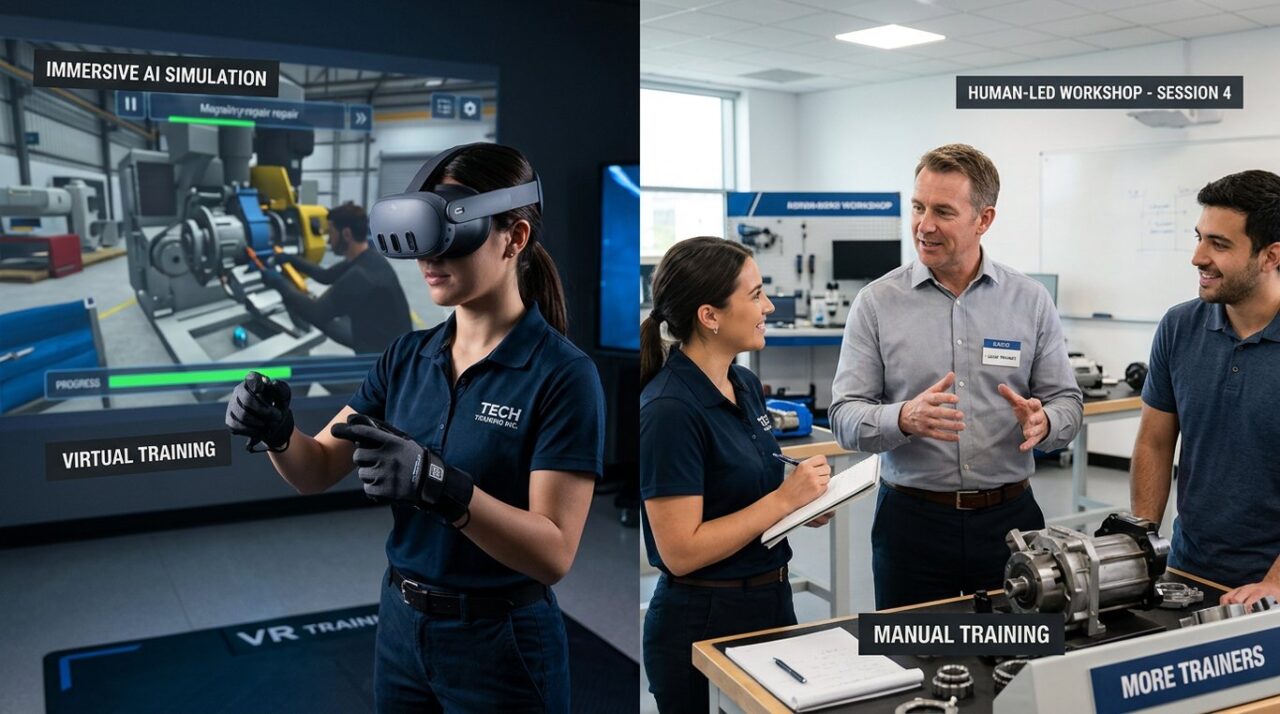
Immersive AI simulation is worth the investment when your organization needs frequent, measurable practice across a large or distributed workforce. Hiring trainers and running live workshops remain better for nuanced coaching, collaboration, and relationship-building, so the strongest 2026 strategy is usually a blended model that combines scalable practice with human guidance.
Table of Contents
- Is immersive AI simulation worth the investment compared with hiring more trainers or running more live workshops?
- Where the costs of trainers, workshops, and AI-powered simulation really come from
- Is immersive AI simulation worth the investment compared with hiring more trainers or running more live workshops for practice and scale?
- How immersive AI role-play changes learner access, confidence, and consistency
- How to measure the return on an immersive training investment
- Is immersive AI simulation worth the investment compared with hiring more trainers or running more live workshops in your organization?
- Frequently asked questions about immersive AI simulation versus trainers and live workshops
Is immersive AI simulation worth the investment compared with hiring more trainers or running more live workshops?
AI simulation training is digital practice that lets people rehearse realistic conversations, decisions, and behaviors with immediate feedback. It is usually worth considering when traditional training cannot provide enough repetition, consistent evaluation, or access across locations.
For enterprise training leaders, the decision is not simply about choosing new technology. It is about finding the best way to build skills across many people, locations, and time zones. Research on immersive learning highlights its potential to support scalable, flexible workforce development through technology-enabled practice and feedback, as discussed in The AI Advantage: Immersive Learning for an Upskilled Workforce.
Immersive AI simulation means digital practice that combines AI Virtual Humans, interactive video, realistic scenarios, and performance analytics. Learners can rehearse sales conversations, customer service moments, leadership challenges, compliance decisions, or healthcare interactions. They receive repeatable practice without waiting for a trainer or risking a real-world mistake.
The question, is immersive ai simulation worth the investment compared with hiring more trainers or running more live workshops, becomes most relevant when practice demand exceeds current capacity.
This includes:
- Global teams that need consistent training across regions
- Distributed or remote workforces
- Roles requiring frequent role-play and feedback
- Limited trainer availability
- High-stakes environments, such as healthcare and compliance
- Sales or service teams that need measurable skill improvement
Comparing the investment options
| Decision factor | Immersive AI simulation | Hiring more trainers | Running more live workshops |
|---|---|---|---|
| Scale | Supports repeatable practice across large, distributed teams | Scale depends on headcount and schedules | Scale depends on rooms, facilitators, and attendance |
| Practice volume | Learners can repeat scenarios on demand | Limited by trainer time | Usually limited to scheduled sessions |
| Consistency | Delivers the same scenario and scoring standards | Can vary by trainer | Can vary by facilitator and group |
| Personalization | AI can respond to learner choices and performance | High, but costly at scale | Moderate, with limited one-to-one time |
| Measurement | Tracks decisions, behaviors, scores, and skill gaps | Often depends on manual observation | Often relies on surveys or facilitator notes |
| Implementation | Requires scenario design, governance, and platform integration | Requires recruiting and onboarding | Requires repeated planning and logistics |
| Cost profile | Upfront platform and content investment, then scalable delivery | Ongoing salary and capacity costs | Recurring facilitator, travel, venue, and coordination costs |
| Bottom Line | Strong fit when demand, scale, and measurement justify the investment | Strong fit for complex coaching and high-touch development | Strong fit for collaboration, discussion, and hands-on group learning |
Simulation-based training is most valuable when practice volume and consistency matter more than a single live event. In 2026, AI simulations can provide structured repetition, while a human coach interprets results and connects them to workplace behavior.
AI roleplay allows learners to respond to a persona that can challenge assumptions, raise objections, or show emotion. A well-designed persona should reflect the customer, patient, manager, or stakeholder that the learner will encounter in real work.
Immersive simulation is not a replacement for every trainer or workshop. Trainers remain valuable for coaching, reflection, and complex judgment. Live workshops also create discussion and team connection that technology cannot fully replicate.
The strongest business case combines methods. Use AI simulation for frequent rehearsal and baseline measurement. Use trainers for targeted coaching and support. Use workshops when teams need collaboration or shared problem-solving.
Virti supports this blended approach through no-code scenario creation, AI Virtual Humans, interactive video, analytics, and delivery across mobile, desktop, and VR. These options can reduce migration risk by fitting into existing learning systems rather than requiring a complete training rebuild.
Before investing, compare the full cost of each option. Include trainer capacity, travel, scheduling, learner downtime, content updates, and measurement. Then connect simulation results to outcomes such as ramp time, win rates, service quality, compliance readiness, or clinical confidence. (Source: Immersive Training Simulations: What Works and Why)
Immersive AI simulation is worth the investment when it delivers more practice, consistency, and measurable business impact than traditional capacity can provide.
The strongest business case is not “technology versus people.” It is scalable practice supported by people who can coach judgment, context, and behavior change.
Where the costs of trainers, workshops, and AI-powered simulation really come from
The total investment in training includes delivery, learner time, content maintenance, access, measurement, and business disruption—not only the price of a platform or facilitator.
When leaders ask, “is immersive ai simulation worth the investment compared with hiring more trainers or running more live workshops,” they often compare license fees with facilitator rates. That misses the bigger picture.
The real cost includes delivery, learner time, content updates, global access, and the ability to repeat practice.
Live workshops cost more than facilitator fees because travel, venues, scheduling, learner downtime, and repeated delivery quickly compound.
Trainer capacity limits how many learners can practice, receive feedback, and access consistent coaching across locations and time zones.
Workshop content requires preparation, rehearsal, localization, and updates whenever products, policies, or customer expectations change.
AI simulation shifts spending toward platform access, scenario creation, implementation, governance, and continuous performance optimization.
No-code authoring can reduce reliance on specialized developers when teams create or update AI-powered training scenarios.
The full cost of live training
A live workshop may appear affordable when measured by a facilitator’s day rate. The full calculation is broader. It can include trainer preparation, room hire, travel, accommodation, printed materials, event coordination, and technology support.
Learners also spend time away from their usual work. For a large team, that lost capacity may exceed the visible workshop invoice. A session delivered to 20 people must also be repeated for another group, location, shift, or language.
Trainer availability creates another constraint. Skilled facilitators cannot coach every learner at once. They may also deliver different feedback from one session to another. That inconsistency can weaken behavior change, especially when practice involves sensitive conversations.
Scaling across countries adds translation, scheduling, local facilitation, and time-zone planning. A workshop model can work well for small, concentrated groups. It becomes harder to manage as the audience grows.
Traditional sales training often depends on scheduled demonstrations, group exercises, and limited opportunities for individual practice. That approach can work for launches, but traditional training may struggle when every learner needs multiple attempts and objective evaluation.
What immersive AI simulation adds to the budget
The question “is immersive ai simulation worth the investment compared with hiring more trainers or running more live workshops” depends on what the platform replaces and how often teams use it.
Costs usually include platform access, scenario design, implementation, integrations, security reviews, governance, and measurement. Content creation often represents the largest investment in immersive learning, rather than the technology alone. (Source: How Much Does Immersive Learning Cost?)
There is also ongoing work. Scenarios need testing, updates, quality checks, and analysis. Organizations should budget for ownership, approval workflows, and responsible AI controls.
Virti’s no-code authoring helps reduce dependence on specialized development resources. Learning teams can create and revise scenarios without building every experience from scratch. Learners can then practice repeatedly through AI Virtual Humans, interactive video, or other accessible formats.
AI-powered immersive learning shifts spending toward reusable content and broader learner access. AI conversation simulations can avoid headset costs, while supporting delivery across desktop, mobile, and VR.
AI-powered immersive sales practice can help a sales team rehearse discovery, objection handling, negotiation, and follow-up without adding another live session.
This changes the cost model. Instead of paying for every live practice opportunity, organizations invest in reusable content and broader learner access. AI conversation simulations can also avoid headset costs, while supporting delivery across desktop, mobile, and VR.
The best comparison is not trainer fees versus software fees; it is total cost per learner, practice opportunity, and measurable improvement.
When those factors are included, asking “is immersive ai simulation worth the investment compared with hiring more trainers or running more live workshops” becomes a practical business decision—not a technology debate.
What are the hidden benefits of simulation-based training?
Simulation-based training provides benefits that are often missed in a simple budget comparison. These benefits include repeatable practice, faster assessment, earlier identification of challenges, consistent standards, and more useful data for managers.
An ai trainer can provide immediate prompts and feedback, while a human expert reviews patterns and decides what intervention is appropriate. This division helps organizations train more people without treating automated feedback as a complete substitute for expertise.
Simulation training can also support agent training in a contact center, where frequent product changes and high interaction volumes make repeated roleplay especially important. Agents can simulate difficult calls, receive an assessment, and retry before handling a real customer.
Is immersive AI simulation worth the investment compared with hiring more trainers or running more live workshops for practice and scale?
AI simulation training is usually the stronger option for frequent, repeatable practice at scale, while trainers and workshops are stronger for nuanced coaching and group collaboration.
Immersive AI simulation uses realistic digital scenarios to let employees rehearse job conversations and decisions. Unlike passive e-learning, learners actively respond, make choices, and receive feedback.
The right choice depends on the skill, audience, and required practice volume. Sales and partner teams may see faster returns from accessible AI conversation simulations than hardware-dependent VR.
Comparing the three approaches
| Requirement | AI simulation with Virtual Humans | More human trainers | More live workshops |
|---|---|---|---|
| Learner access | Available on mobile, desktop, or VR. Employees can practice across locations and time zones. | Limited by trainer schedules, location, and capacity. | Usually tied to fixed dates, rooms, and attendance. |
| Practice volume | Supports repeatable practice without adding trainer hours. Learners can retry difficult moments. | Practice depends on trainer availability and group size. | Often provides limited attempts during a session. |
| Personalization | Scenarios can adapt to role, skill level, responses, and business needs. | Highly personalized when trainer capacity allows. | Personalization can be difficult across a large group. |
| Feedback speed | Immediate feedback can highlight missed questions, tone, behaviors, or compliance steps. | Detailed feedback, usually after the interaction. | Feedback may focus on selected participants or group discussion. |
| Consistency | Delivers the same standards, scenario logic, and scoring across teams. | Quality can vary between trainers and sessions. | Content can vary with facilitation, time, and group dynamics. |
| Safe role-play | Creates a low-risk space for sales objections, complaints, leadership moments, and compliance interactions. | Safe when trust is strong, but some learners may still feel exposed. | Useful for group practice, though public mistakes can reduce participation. |
| Cost and scale | Requires platform setup, scenario design, governance, and licensing. Costs can scale more efficiently across large teams. | Adds recurring staffing costs as demand grows. | Adds facilitator, travel, venue, and employee time costs. |
| Human judgment | Strong for structured practice and measurable behaviors. | Best for nuance, coaching judgment, and complex behavior change. | Strong for discussion, relationships, and shared learning. |
| Bottom Line | Best for frequent, repeatable practice at scale. | Best for coaching depth and sensitive development. | Best for collaboration, launches, and high-touch learning events. |
AI-powered immersive sales training gives sales professionals a repeatable environment for discovery calls, objection handling, negotiation, and account conversations. It can supplement sales training without requiring a facilitator to observe every attempt.
AI Virtual Humans make practice more accessible without making it feel like a quiz in disguise. A learner can handle an angry customer, challenge a sales objection, deliver difficult feedback, or complete a regulated interaction. They can repeat the scenario until the response improves.
That repeatability matters when employees need confidence, not just awareness. Virti combines AI Virtual Humans, interactive video, analytics, and cross-platform access. Its no-code authoring approach can help teams create and update scenarios without specialized development resources. The strongest programs focus on safer rehearsal and skill transfer, rather than technology that merely looks futuristic. (Source: AI Immersive Skill Training Simulations: 20 Advances (2026))
AI roleplay can support sales, service, leadership, and compliance scenarios. Unlike a static script, it lets learners simulate changing customer reactions and practice how to respond under pressure.
Human trainers still play a central role. They can identify hidden concerns, adjust coaching to the person, and lead nuanced debriefs. They also build relationships and support behavior change when emotions, politics, or clinical judgment are involved.
For most enterprises, the practical answer is a blended model. Use simulation before workshops to build confidence and collect performance data. Use trainers for coaching, reflection, and complex cases. A pilot can test one priority workflow, measure completion and improvement, then expand through existing LMS and governance processes.
So, is immersive ai simulation worth the investment compared with hiring more trainers or running more live workshops? Yes—when frequent, consistent practice matters, while trainers remain essential for judgment, relationships, and deeper behavior change.
How immersive AI role-play changes learner access, confidence, and consistency
AI role-play gives learners private, repeatable practice that can improve access, confidence, consistency, and readiness before real-world interactions.
TL;DR: Immersive AI simulation gives employees private, repeatable practice without waiting for a workshop. For global teams, it can make critical behaviors more consistent while improving confidence, readiness, and real-world performance.
Practice when learners need it
Live workshops create valuable human connection, but access is limited. Employees must wait for a scheduled date, travel, and often practice in front of colleagues. That pressure can make people avoid difficult conversations or stick to safe answers.
Immersive AI role-play removes those barriers. Learners can practice privately on a phone, desktop, or VR device. They can repeat a scenario until the response feels natural, without booking another trainer or waiting for the next cohort. Broader research on how AR and VR are transforming training similarly emphasizes flexible, experiential practice as a major benefit of immersive learning.
Psychologically safe practice means learners can make mistakes, receive feedback, and try again without embarrassment or professional risk. Research describes unlimited, targeted practice as a key reason AI role-play can improve skill transfer. (Source: Practice makes profitable: How immersive AI roleplay drives productivity, ROI and lasting skill transfer)
Virtual Humans and interactive video also create a more active experience than watching slides or completing a quiz. A customer may challenge a policy, a buyer may raise an objection, or a manager may respond emotionally. Learners must listen, think, and choose what to say next.
This practice builds confidence through action, not recognition. One report cites learners becoming 275% more confident when using immersive simulation-based training. (Source: AI Role-Playing for Training: Transform Corporate Learning with Immersive Simulations in 2026)
Consistent practice across global teams
Live role-play can vary by facilitator, location, and group dynamics. One region may rehearse a scenario weekly, while another receives a short workshop once each quarter. Feedback may also depend on which manager leads the session.
AI simulations provide the same core scenario and success criteria to every learner. Teams can rehearse sales discovery, customer service, leadership, compliance, or safety behaviors across regions. This supports consistent standards, regardless of geography or cohort size.
Consistency does not mean every learner receives the same conversation. Virtual Humans can respond to each person’s wording, tone, and choices. Learners can face different objections or difficulty levels while practicing the same critical behavior.
For buyers asking, is immersive ai simulation worth the investment compared with hiring more trainers or running more live workshops, the learning experience is a major part of the answer. More access and better repetition can improve readiness, communication confidence, customer experience, sales execution, and safer decisions.
Soft skills training benefits from repeated conversation practice because listening, empathy, questioning, and de-escalation are difficult to master through information alone. The best soft skills programs pair simulation training with reflection and human coaching.
Virti supports this learning loop with no-code scenario creation, AI Virtual Humans, interactive video, analytics, and delivery across desktop, mobile, and VR. It can complement workshops by giving learners practice before and after live sessions.
The strongest case for immersive AI simulation is simple: it turns occasional practice into consistent, measurable rehearsal that helps people perform when the conversation matters.
AI simulations create the most impact when each scenario is tied to a specific behavior, a measurable assessment, and a business outcome.
How to measure the return on an immersive training investment
A reliable ROI evaluation connects simulation usage and assessment data with operational outcomes such as proficiency, conversion, quality, safety, or customer satisfaction.
To answer is immersive ai simulation worth the investment compared with hiring more trainers or running more live workshops, measure business improvement—not just course completion. A simulation can be popular and still fail to improve performance. Your ROI framework should connect practice data with operational results.
What should you measure?
Training ROI is the financial value created by improved performance, reduced costs, or lower risk, compared with the training investment.
Track four layers of evidence:
- Usage: enrollment, completion, repeat attempts, and time spent.
- Practice quality: practice frequency, scenario scores, response patterns, and confidence.
- Competency: improvement between attempts, time to proficiency, and manager observations.
- Business impact: sales conversion, customer satisfaction, errors, escalations, compliance results, or employee ramp time.
For example, a sales team might complete an average of four practice sessions per month. After six weeks, managers could assess whether discovery questions improved. The final measure might be a 6% increase in qualified opportunities.
Do not treat completion as the finish line. It is only the first signal.
Assessment should measure observable behaviors, not merely whether a learner selected the correct answer. An assessment can score questioning, empathy, accuracy, compliance language, escalation choices, and the ability to respond to changing challenges.
The ai simulation training statistics that matter most are therefore connected to performance: repeat attempts, assessment improvement, time to proficiency, and post-training outcomes. Simulation training statistics become more useful when compared with a baseline and segmented by role, location, or experience.
Why compare results with a baseline?
A baseline shows what performance costs before simulation begins. Record current results for the same period, team, or role.
Compare simulation outcomes with:
- Workshop delivery and facilitator costs
- Trainer hours spent on repeated coaching
- Employee travel and time away from work
- Time to proficiency for new hires
- Product errors, service escalations, or safety incidents
- Missed sales opportunities
- Compliance failures and remediation costs
For example, suppose live workshops cost $40,000 per quarter. They reach 100 employees, while 500 employees need practice. A simulation pilot may require an upfront content and platform investment. However, repeated practice can reach more learners without repeating the full facilitation cost.
Research suggests immersive learning economics can compare favorably with traditional delivery over 12 to 24 months. (Source: Immersive Learning vs Traditional Training: 2026 Stats)
The key question is not whether simulation costs less on day one. Ask whether it improves results at a lower cost per proficient learner.
How can Virti analytics guide the decision?
Virti analytics help learning teams see what happens inside each scenario. Review where learners hesitate, which responses appear often, and where performance breaks down.
Use these insights to identify:
- Common skill gaps across teams or regions
- Scenarios that are too easy or too difficult
- Responses linked with strong or weak outcomes
- Learners who need targeted coaching
- Content that needs clearer guidance or updated examples
This creates a practical improvement loop: create, practice, analyze, and refine. Managers can combine simulation data with observations from real customer or employee interactions.
How should you run a pilot?
Start with one high-value use case. Choose a problem with measurable cost, such as sales ramp time, service escalations, or compliance errors.
Set success criteria before launch. For example:
- 80% completion within six weeks
- Three practice attempts per learner
- 15% competency improvement
- 10% faster time to proficiency
- 5% fewer escalations within one quarter
Compare pilot results with a similar baseline group. Then decide whether to expand across teams, regions, or programs.
To decide is immersive ai simulation worth the investment compared with hiring more trainers or running more live workshops, prove improvement against a baseline before scaling. A focused pilot turns a promising idea into a measurable business case.
Evaluation should continue after launch. Review scenario quality, assessment reliability, learner adoption, manager feedback, and business outcomes at 30, 60, and 90 days.
Is immersive AI simulation worth the investment compared with hiring more trainers or running more live workshops in your organization?
The best investment depends on your practice demand, audience, risk profile, and need for scalable assessment. In 2026, organizations with distributed teams often gain the most from a blended learning model that combines AI practice with human facilitation.
The answer depends on your workforce, training goals, and delivery limits. Immersive AI simulation means realistic, repeatable practice with an AI-driven character or scenario. It does not always require a VR headset. Learners can practice through mobile, desktop, or VR experiences.
If you are asking, “is immersive ai simulation worth the investment compared with hiring more trainers or running more live workshops,” start with your practice demand. How many people need training? How often do they need it? Can facilitators provide consistent feedback at the required scale?
| Investment option | Strong fit | Main limits | Best value |
|---|---|---|---|
| Immersive AI simulation | Large or distributed teams, frequent onboarding, high-stakes conversations, and repeated practice needs | Requires scenario design, governance, and adoption planning | Scalable practice, consistent measurement, and flexible access |
| More trainers | Small cohorts, highly bespoke coaching, and complex development needs | Hiring and scheduling costs can rise quickly | Deep feedback, mentoring, and relationship-led development |
| More live workshops | Teams that benefit from discussion, collaboration, or behavior change in groups | Limited repetition and higher coordination costs | Shared learning, team alignment, and facilitated practice |
| Blended model | Enterprises balancing scale with human coaching | Needs clear ownership between technology and facilitators | AI-supported rehearsal with expert feedback |
| Bottom Line | Use simulation when practice must scale. Use trainers when judgment and relationships lead. Combine both for the broadest impact. | — | — |
Simulation-based programs are especially useful when organizations need common standards across locations. They can help train new hires, support ongoing sales training, and provide an assessment before someone handles a high-risk interaction.
When immersive AI simulation is a strong fit
This approach often makes sense for global teams, contact centers, sales organizations, and regulated workforces. It can support frequent onboarding without adding a trainer for every new cohort. Learners can repeat difficult conversations until they improve, without waiting for the next workshop.
It is especially useful for high-stakes situations. Examples include handling customer complaints, giving feedback, discussing compliance risks, or responding to sensitive healthcare scenarios. AI-powered simulations can provide a safer first rehearsal than practicing on customers, colleagues, or patients.
The model also helps when facilitator capacity is limited. Virti enables teams to create scenarios without specialized development resources. Learners receive consistent practice, while leaders can review performance data and identify common skill gaps. Research on immersive training highlights the value of linking simulation results to outcomes such as ramp time, win rates, and deal velocity.
AI sales training can use a roleplay scenario to test discovery questions, product knowledge, objection handling, and next-step discipline. This creates a more practical alternative to sales training tools that measure only content recall.
When trainers or workshops should come first
More trainers or live workshops may be the better first investment for small cohorts. They also suit highly bespoke coaching, executive development, and relationship-led learning. Some skills depend on trust, group discussion, or nuanced feedback that technology cannot fully replace.
A blended model usually offers the strongest long-term option. Virti can handle scalable practice, scenario repetition, and measurement. Trainers can focus on facilitation, coaching, feedback, and strategic development. This gives people more chances to rehearse while preserving the human moments that change behavior.
Before choosing, check enterprise requirements. Virti supports mobile, desktop, and VR delivery, plus LMS integrations for broader rollout. Review data governance, access controls, retention policies, and privacy-conscious AI usage with your security team. Virti also provides ISO-certified security for enterprise environments.
Virtual reality can increase presence for physical, spatial, or safety scenarios, but desktop and mobile access may provide better reach for conversation-based programs. The right technology depends on learner access, scenario risk, and the outcomes you need.
Blended learning combines simulation-based practice, live discussion, manager coaching, and on-the-job application. This approach addresses the limitations of any single method and can improve transfer.
So, is immersive ai simulation worth the investment compared with hiring more trainers or running more live workshops? Choose Virti when your organization needs repeatable practice at scale, then use trainers to turn that practice into performance.
Frequently asked questions about immersive AI simulation versus trainers and live workshops
These frequently asked questions explain when AI simulation training, human coaching, live workshops, and blended delivery provide the strongest business case.
Is immersive AI simulation cheaper than hiring more trainers or running more workshops?
Immersive AI simulation can reduce the cost of repeated practice, travel, facilitation, and scheduling at scale. Live workshops still have value, but each session requires trainer time, rooms, and learner coordination. AI Virtual Humans allow employees to practise difficult conversations repeatedly without booking another class. This can make is immersive ai simulation worth the investment compared with hiring more trainers or running more live workshops a clear yes for large, distributed teams. The strongest savings appear when many employees need consistent practice across locations, languages, or time zones.
Can AI simulation replace human trainers?
AI simulation supports human trainers rather than replacing them completely. Trainers remain valuable for coaching, teaching concepts, handling sensitive discussions, and interpreting business context. AI-powered role-play handles repeatable practice and gives learners a safe space to make mistakes. Trainers can then focus on higher-value feedback instead of repeating the same demonstration. This blended model expands training capacity without removing human judgment. It also helps learners build confidence before practising with customers, colleagues, patients, or other high-stakes audiences.
What types of training work best with AI Virtual Humans and immersive video?
AI Virtual Humans work best for training that requires conversation, judgment, empathy, or repeated decision-making. Common examples include sales discovery, customer service, leadership feedback, conflict management, interviews, compliance conversations, and healthcare communication. Immersive video can show realistic situations, while AI role-play lets learners choose and practise responses. Research suggests immersive learning works best when it improves skill transfer and deliberate practice, rather than simply adding futuristic visuals (Source: AI Immersive Skill Training Simulations: 20 Advances (2026)).
How do enterprises measure ROI from immersive AI role-play?
Enterprises measure ROI by linking practice data to changes in performance, confidence, quality, and business outcomes. Useful measures include completion rates, assessment scores, time to proficiency, coaching hours saved, conversion rates, customer satisfaction, and compliance results. Virti analytics can help identify common mistakes and compare performance across teams. A strong pilot should establish a baseline before launch, then track improvement against it. This makes is immersive ai simulation worth the investment compared with hiring more trainers or running more live workshops a measurable business question, not a technology debate.
Can Virti work across devices and existing learning systems?
Virti supports mobile, desktop, and VR delivery, with integrations that can connect training to existing LMS platforms. This lets enterprises offer the same scenario through the device each learner can access. VR can create deeper immersion, while mobile and desktop support wider adoption without specialist hardware. Existing learning systems can remain the home for assignments, records, and reporting. This flexible approach avoids requiring every employee to own a headset, a barrier highlighted in reviews of immersive training solutions.
How quickly can an enterprise launch an AI-powered scenario?
An enterprise can often create and launch an AI-powered scenario in days or weeks, depending on its complexity and approval process. Virti’s no-code authoring reduces the need for specialist developers. Teams can define learning goals, write the scenario, configure the Virtual Human, test the experience, and release it to a pilot group. Larger programmes may need more time for brand, legal, privacy, language, and LMS reviews. Starting with one high-value use case usually delivers faster learning and clearer evidence for wider rollout.
Is immersive AI simulation secure for regulated industries?
Immersive AI simulation can suit regulated industries when the platform provides strong security, governance, privacy controls, and human oversight. Buyers should review data handling, access permissions, retention, hosting, audit records, and vendor certifications. Virti is designed for enterprise use, with ISO certifications and privacy-conscious AI practices. Regulated teams should also approve scenario content and avoid unnecessary personal or sensitive data. Begin with fictional cases or controlled information, then expand after security and compliance teams approve the workflow.
Key Takeaways
- AI simulation training is most valuable when learners need frequent, repeatable practice.
- Hiring trainers remains the stronger choice for nuanced coaching, mentoring, and complex judgment.
- Live workshops are valuable for collaboration, discussion, alignment, and shared problem-solving.
- Simulation training can expand access across mobile, desktop, and VR.
- Use assessment data to identify skill gaps, challenges, and improvement between attempts.
- Compare outcomes with a baseline rather than measuring completion alone.
- A simulation-based pilot can test adoption, confidence, proficiency, and business impact.
- The strongest sales training strategy combines AI roleplay, manager coaching, and real-world application.
- In 2026, blended learning can balance scalable technology with human expertise.
- AI simulations should support—not eliminate—human judgment, governance, and coaching.
The clearest answer to is immersive ai simulation worth the investment compared with hiring more trainers or running more live workshops is: use AI simulation to scale practice, while keeping human trainers for coaching, judgment, and trust.