In 2027, AI training platforms are drastically changing how organisations upskill their people. From realistic simulations to conversational AI agents, these solutions immerse learners in safe, hands on practice environments that boost confidence and performance.
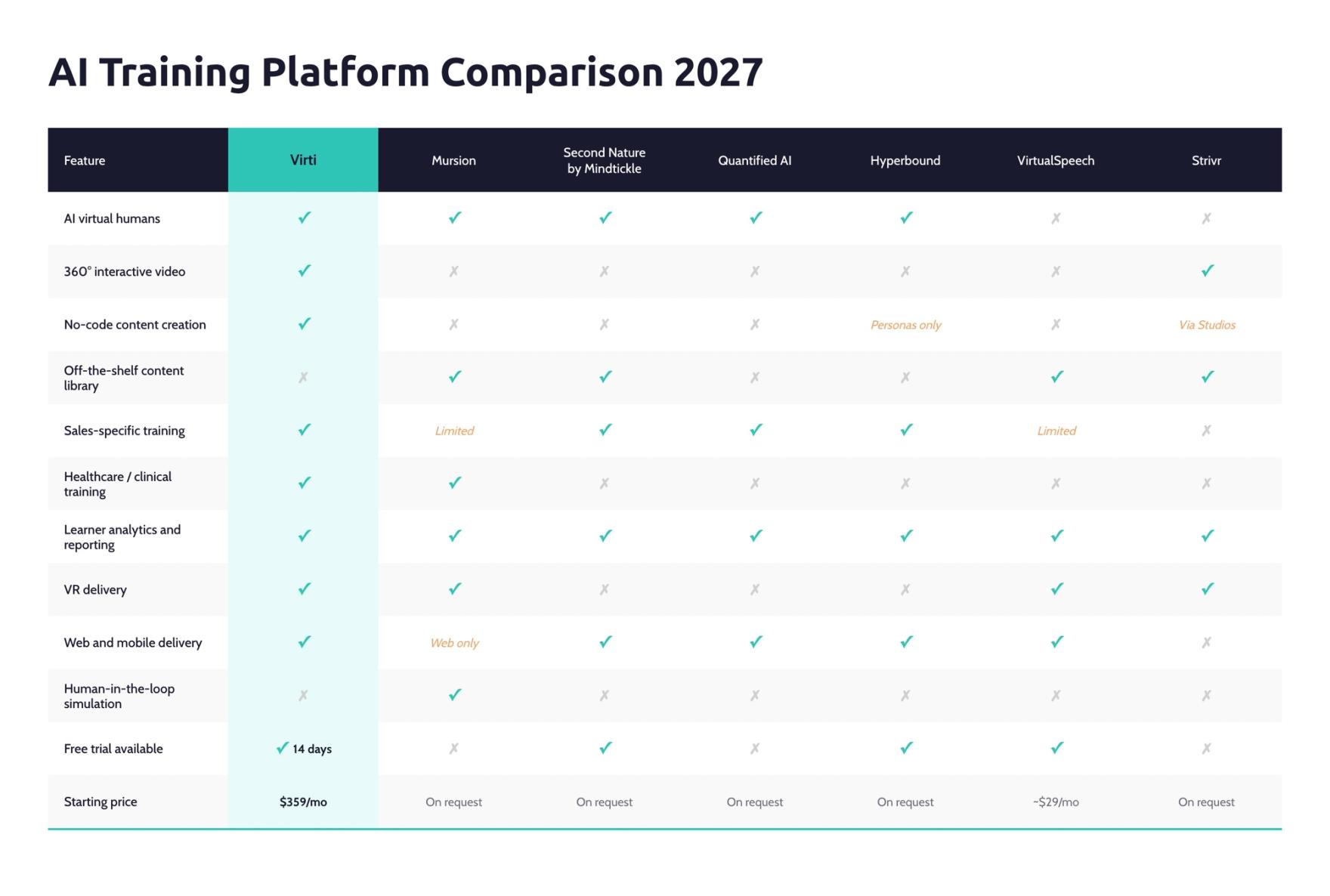
Below, we compare seven leading AI training platforms in 2027, their best features, pricing models, and which sectors they specialise in. Each brings something unique to the table, but one platform in particular stands out as the leader in immersive AI training.
The quick answer: the best AI training platform depends on what you need to train. For AI roleplay across sales, leadership, healthcare and customer service on one platform, Virti is the strongest all round choice. Second Nature by Mindtickle, Quantified AI and Hyperbound focus on sales; Mursion specialises in human led simulations; Bodyswaps suits education and early careers; and Strivr is built for large scale VR deployments.
What Is an AI Training Platform?
An AI training platform uses artificial intelligence to help people learn and practise skills. The most effective platforms go beyond delivering content: learners hold realistic conversations with AI characters, receive instant feedback on how they performed, and managers get data showing who is improving and where skills gaps remain.
AI Training Platforms Compared

1. Virti
Virti is an AI roleplay and immersive learning platform that uses learning technology to bring complex training scenarios to life. Virti initially revolutionised healthcare simulation and now helps organisations across many industries to create and scale interactive training content.
The platform is known for its AI powered Virtual Humans, which use realistic role plays to train skills like leadership, emotional intelligence and active listening. Virti's mission is to make training accessible and engaging to everyone at an affordable price.
Key Features
- AI Virtual Humans for role play: Virti's lifelike virtual characters engage learners in dynamic conversations, responding naturally to what they say. Learners can practise difficult conversations, such as patient interactions or customer service scenarios, with realistic emotional responses.
- No code scenario creation: Trainers can build custom AI roleplay scenarios from a simple prompt or their existing training materials, without any coding. Brand documents can be added to a knowledge bank that Virtual Humans draw on, so every conversation reflects the organisation's own content.
- AI Coaching and detailed feedback: After every session, learners see exactly what they said that met each evaluation point, so feedback is specific and evidence based. Virti AI Coaching remembers every session and builds on each learner's progress over time.
- Analytics and reporting: Dashboards show how individuals and teams are developing and where skills gaps remain, and reports can be exported to share with stakeholders.
- Accessible anywhere: Virti runs in web browsers and on mobile devices, so learners can practise anytime, anywhere, whether preparing for a difficult clinical conversation or rehearsing a sales pitch on their phone.
Pricing
Virti offers three plans to fit different team sizes:
- Teams: $359 per month (billed annually at $4,308), for small teams getting started with AI roleplay.
- Business: $1,079 per month (billed annually at $12,948), for growing L&D teams that need more learners, Virtual Humans and LMS integration.
- Enterprise: From $25,000 per year, for large organisations needing unlimited scale, security and dedicated support, with custom pricing and multiyear discounts available.
Virti offers a 14 day free trial on every plan, and its accessible entry tier reflects the company's goal of making immersive training widely available.
Best Suited For
Virti shines in sales, leadership, healthcare and customer service training. Hospitals and medical schools use Virti to simulate high risk clinical conversations in a safe environment, and in healthcare simulation Virti has delivered a 91% cost reduction. Retailers, service companies and sales teams use it for customer experience training and sales role plays, areas where realistic practice builds confidence. In one global sales pilot, reps completed an average of 32.5 voluntary practice sessions each. For any organisation seeking a comprehensive and affordable AI training solution, Virti is the most versatile choice on this list.

2. Mursion Training
Mursion is an upskilling platform that delivers immersive simulations for interpersonal skills by blending AI technology with human insight. A pioneer in virtual role play for workplace learning, Mursion offers realistic scenarios in which learners interact with virtual avatars to practise difficult conversations, for example delivering feedback, de escalating an angry customer, or managing a diversity dialogue in a judgement free environment.
What makes Mursion unique is its hybrid approach. Many simulations are guided by live human simulation specialists behind the scenes, combined with AI, to produce incredibly lifelike interactions.
Key Features
- Hybrid AI and Human Simulations: Mursion's flagship service uses a live human interactor aided by AI to control avatars in real time. This AI powered, human driven approach yields highly realistic conversations. The virtual characters can show emotion, adapt to the learner's words, and even improvise within the scenario.
- On Demand AI Scenarios: To complement its live sessions, Mursion introduced fully AI driven simulations for 24/7 training access. Learners can log in and practise with intelligent avatars anytime, without scheduling a live actor.
- Scenario Library and Customisation: Mursion comes with a rich library of scenarios addressing customer service, leadership, sales, education and DEI use cases. Organisations can tailor these scenarios or create new ones to reflect their specific challenges.
- Analytics and Coaching Feedback: After each simulation, learners receive feedback on their performance. Sessions can be recorded for review, and Mursion provides insights on things like conversation strategy and empathy demonstrated.
Pricing
Mursion is an enterprise solution with pricing available on request, as costs vary based on the number of sessions and level of human facilitation. There is no free version, but Mursion encourages interested businesses to schedule a demo.
Best Suited For
Mursion is ideal for organisations that prioritise soft skill development and are willing to invest in high quality simulations. Large corporations use Mursion to train leaders in emotional intelligence, to coach managers in giving feedback, and to prepare customer facing staff for tough interactions. Because of the cost, Mursion finds its sweet spot with mid size and enterprise organisations that need a scalable way to practise human centric skills.

3. Second Nature by Mindtickle
Second Nature, now part of the Mindtickle platform following its acquisition, is a specialised AI sales training tool that functions like a virtual sales coach. It provides a virtual role play partner, an AI persona, that engages sales reps in back and forth dialogue, then evaluates and guides them. Reps can practise sales calls and pitches with this conversational AI as if they were talking to a customer, without needing a human role play partner.
Key Features
- Conversational AI Partner: Second Nature's core feature is its AI driven role play partner. This AI can have actual spoken conversations with a rep, simulating prospects or clients. It responds contextually to the rep's pitch and questions, making the exchange feel authentic. This allows salespeople to practise sales calls, demos and elevator pitches on demand.
- Real Time Feedback and Coaching: After the session, Second Nature provides a score or performance summary, highlighting things like which selling points the rep covered or skipped, how persuasive their answers were, and any areas for improvement.
- Custom Scenario Creation: Organisations can upload their own sales scripts, product information and playbooks to create custom training scenarios. Second Nature comes with templates for industries like tech, insurance and banking, but users can also build simulations from scratch.
- Analytics Dashboard for Managers: Sales managers and enablement teams can access a dashboard with analytics on each rep's practice sessions, seeing who has practised which pitch, scores over time, and AI transcripts.
Pricing
As part of the Mindtickle platform, pricing is available on request and typically scoped to the number of users and features required. A free trial or pilot period is available for companies wanting to test before a full rollout.
Best Suited For
Second Nature is purpose built for sales teams and excels with companies that have sizable sales forces or inside sales teams, such as tech, SaaS, finance, insurance and telecoms, where reps must master complex pitches. New sales hires can onboard faster by practising with the AI, while veteran reps can continually refine their techniques.
4. Quantified AI
Quantified AI is an AI sales coaching platform focused on measuring and improving sales rep readiness through realistic practice and objective performance scoring. Rather than relying on manager observation or call recording review alone, Quantified uses AI to assess how reps communicate during practice sessions, scoring them against defined competencies and providing feedback on delivery, confidence, and message clarity.
Key Features
- AI Powered Practice Conversations: Quantified places reps in realistic sales conversations with AI driven virtual buyers that respond dynamically to what the rep says. This gives reps a safe environment to practise pitches, objection handling and discovery conversations before facing real prospects.
- Competency Based Scoring: Every practice session is scored against defined sales competencies, such as clarity of value proposition, handling of objections, and conversational confidence. This produces objective, consistent readiness data that managers can use to identify who is ready for live selling and who needs additional practice.
- Readiness Dashboards for Managers: Sales leaders and enablement teams can see individual and team level readiness data across the whole sales force: identifying skill gaps, tracking improvement over time, and making data driven decisions about coaching priorities and deployment readiness.
- Personalised Coaching Feedback: After each session, reps receive specific feedback on what they did well and where to improve, with guidance tied to the competencies their organisation has defined as important.
Pricing
Quantified AI offers pricing on request, tailored to team size and requirements. Interested organisations are encouraged to request a demo to explore options.
Best Suited For
Quantified AI is best suited for sales enablement teams that want objective, data driven readiness measurement alongside practice. It works particularly well for organisations that need to certify reps as ready before deploying them on live calls, or that want to replace subjective manager assessment with consistent, scalable scoring. Teams looking for broader immersive learning across functions beyond sales will find its scope more limited than a platform like Virti.

5. Hyperbound
Hyperbound is an AI sales training platform focused on helping sales teams, particularly SDRs and BDRs, build cold calling and outbound confidence through realistic AI roleplay. The platform allows sales managers to create AI buyer personas quickly, giving reps a dynamic practice environment for the high volume, repetitive call types that define early funnel sales work.
Key Features
- AI Buyer Personas: Hyperbound lets teams build configurable AI prospects that simulate real buyer behaviour: pushing back on pitches, raising objections, and responding to what the rep actually says rather than following a fixed script. Personas can be tailored to specific industries, roles and objection types.
- On Demand Cold Call Practice: Reps can practise cold calls, discovery openers and objection handling on demand, without needing a manager or colleague to play the prospect. This removes the scheduling friction that limits how much repetition most sales teams can realistically get.
- Call Scoring and Feedback: After each practice session, Hyperbound scores the rep's performance and provides feedback on areas including talk track adherence, objection handling, and conversational flow. Managers can track individual rep progress and identify who is ready for live calling.
- Fast Scenario Creation: Sales managers can build new AI buyer personas quickly, making it practical to keep practice scenarios aligned with current campaigns, target personas and competitive positioning.
Pricing
Hyperbound offers pricing on request, with plans tailored to team size and usage. A free trial is available for teams wanting to test the platform before committing.
Best Suited For
Hyperbound is best suited for SDR and BDR teams focused on outbound sales, cold calling volume and early funnel confidence. It is a strong choice for sales organisations that need to ramp new hires quickly on high volume call types. Teams looking for full cycle sales training or practice across functions beyond sales will find its scope more limited than a broader platform like Virti.
6. VirtualSpeech
VirtualSpeech is an AI-powered platform focused on communication and soft skills training, combining VR simulations with speech analysis to help people practise public speaking, presentation skills, interviews, and workplace conversations. It is used across corporate learning, higher education, and professional development programmes.
Key Features
AI Speech Analysis: VirtualSpeech analyses how users communicate during practice sessions — tracking pace, filler words, eye contact, and clarity — and provides specific feedback after every session. This makes it particularly effective for building confidence in high-stakes communication scenarios like presentations, pitches, and interviews.
VR and Web-Based Simulations: Learners can practise in immersive VR environments, a virtual conference room, a job interview setting, a public speaking stage or access the same scenarios on desktop without a headset. This flexibility makes it practical for both individual practice and organisational deployment.
Off-the-Shelf Scenario Library: VirtualSpeech offers a library of ready-made scenarios covering public speaking, active listening, difficult conversations, sales pitches, and job interviews. Organisations can deploy these immediately without custom content development.
LMS Integration and Analytics: VirtualSpeech integrates with common LMS platforms and provides completion tracking and performance data, making it practical for L&D teams running structured communication skills programmes.
Pricing
VirtualSpeech offers individual and team plans, with team pricing available on request. Individual plans start from around $29 per month, making it one of the more accessible options on this list for smaller teams or individual learners.
Best Suited For
VirtualSpeech is best suited for organisations focused on communication and presentation skills development — corporate teams preparing for high-stakes presentations, HR teams running interview coaching, and L&D programmes targeting public speaking confidence. Its speech analysis features make it particularly strong for scenarios where delivery matters as much as content. Teams looking for broader AI roleplay across sales, healthcare, or leadership will find its scope more specialised than a platform like Virti.
7. Strivr
Initially born out of Stanford VR research used to train quarterbacks off the field, Strivr has grown into a platform that helps companies like Walmart, FedEx and Bank of America elevate employee performance through immersive experiences. Strivr's platform allows organisations to deploy VR training to thousands of employees consistently and securely, with centralised content management and analytics.
Key Features
- Scalable VR Content Delivery: Strivr is built to deliver VR training at scale, providing a central hub where learners can browse and launch training modules assigned to them. This is important for large organisations, allowing employees at any location to put on a headset and access the same standardised training content.
- Extensive Training Content: Strivr helps companies develop VR content through its Strivr Studios team and also offers pre built VR training modules for common needs, including customer service, workplace safety and equipment operation.
- AI Driven Insights: Strivr emphasises not just the VR experience but also the data it generates. The platform can capture telemetry data during training, showing where a learner looked, how they moved, and how quickly they responded to prompts.
- Enterprise Security and Integration: Being enterprise focused, Strivr has robust user management, security and integration features, including single sign on and LMS integration.
Pricing
Strivr's pricing is tailored to each enterprise deployment and not publicly disclosed. Typically, Strivr engages in multiyear contracts encompassing platform licences, content creation services and support.
Best Suited For
Strivr is best suited for large organisations, especially those with distributed frontline workforces in retail, logistics, manufacturing and hospitality. The platform is ideal for any enterprise needing to standardise training across many locations, ensuring that every employee gets the same quality of training regardless of where they are based.
How to Choose the Right AI Training Platform
Before you compare demos, get clear on what you need the platform to do. These questions will narrow the list quickly:
- Which skills and teams? Sales only tools suit sales only needs. If you need to train leaders, clinicians and customer service teams too, choose a platform that covers them all.
- How realistic are the conversations? Look for AI characters that respond to what learners actually say, not fixed scripts.
- How useful is the feedback? The best feedback shows learners exactly what they said and what to improve, not just a score.
- How easy is it to create content? Check whether your team can build and update scenarios from your own materials without specialist help.
- What data will you get? Analytics should show progress across individuals and teams, and be easy to share with stakeholders.
- Does the pricing fit? Transparent plans and a free trial make it far easier to test before you commit.
Conclusion: Which AI Training Platform Should You Choose?
Immersive, AI driven training has come a long way and, as this list shows, organisations in 2027 have powerful options to choose from. From Virti's all in one immersive platform transforming healthcare, sales and customer service training, to specialised tools like Second Nature by Mindtickle for AI sales coaching, Mursion for high fidelity role play, and Hyperbound for SDR and outbound confidence, the leading platforms are delivering clear results. Solutions like Quantified AI, VirtualSpeech and Strivr each excel in their domains, whether it is sales readiness measurement, communication and presentation skills development, or large scale enterprise VR deployment.
However, Virti stands out as the leader in AI powered training. With AI Virtual Humans, AI Coaching and scenarios built from your own content, Virti offers unmatched versatility: it can train a clinician, a store manager and a sales rep all on one platform. Its proven impact in fields like healthcare, improving patient safety through better trained clinicians, and sales, enhancing performance through realistic practice, underscores its market leading status.
In a rapidly evolving training landscape, Virti's clear vision, innovative features and scalable approach put it at the forefront. Organisations looking to elevate their workforce training will find that Virti's solution inspires learning through experience and delivers the expertise needed to thrive in the future of work. Start a free trial here.
Frequently Asked Questions
What is the best AI training platform?
It depends on your goals. For organisations that want AI roleplay across sales, leadership, healthcare and customer service on a single platform, Virti is the most versatile option. Sales focused teams may also consider Second Nature by Mindtickle, Quantified AI or Hyperbound, while Strivr suits very large VR deployments.
What does an AI training platform do?
An AI training platform helps people build skills through realistic, AI powered practice. Learners hold conversations with AI characters, get instant feedback on their performance, and managers use analytics to track progress and identify skills gaps.
How much do AI training platforms cost?
Pricing varies widely. Virti publishes its plans, starting from $359 per month with a 14 day free trial, while most enterprise focused platforms such as Mursion, Strivr and Bodyswaps offer custom pricing on request.
Is an AI training platform the same as AI training jobs?
No. AI training jobs involve people helping to train AI models, for example by labelling data or reviewing AI responses. An AI training platform does the opposite: it uses AI to train people, giving employees realistic practice and feedback so they can build skills faster.