
Upskilling
5 min read
A breakthrough in medical education is quietly transforming patient care across Taiwan’s healthcare system and it’s measuring something previously thought unmeasurable: human empathy.
At a leading hospital in Taipei, a nurse with 10 years of experience recently completed a series of virtual reality training sessions. Her technical knowledge scored 80%. Her empathy skills? Just 40%.
For the first time in healthcare history, administrators could quantify not just what their staff knew, but how compassionately they delivered care.
The Problem That Sparked Innovation
The catalyst came from a real incident: A patient smoking dangerously close to oxygen equipment in a hospital room. When a nurse asked him to stop, he struck her. The nurse, despite her training, was completely unprepared for such an aggressive response.
“The nurse was shocked because she didn’t expect the patient would react like this,” explains Lewis Chang, who’s leading the implementation of AI-powered virtual human training across Taiwan’s major hospital systems.
This scenario—and hundreds like it—led Chang to a revolutionary realization: Healthcare workers weren’t just facing a skills gap, they were facing an empathy and communication crisis that traditional training couldn’t address.
The Solution: Virtual Humans as Quality Control
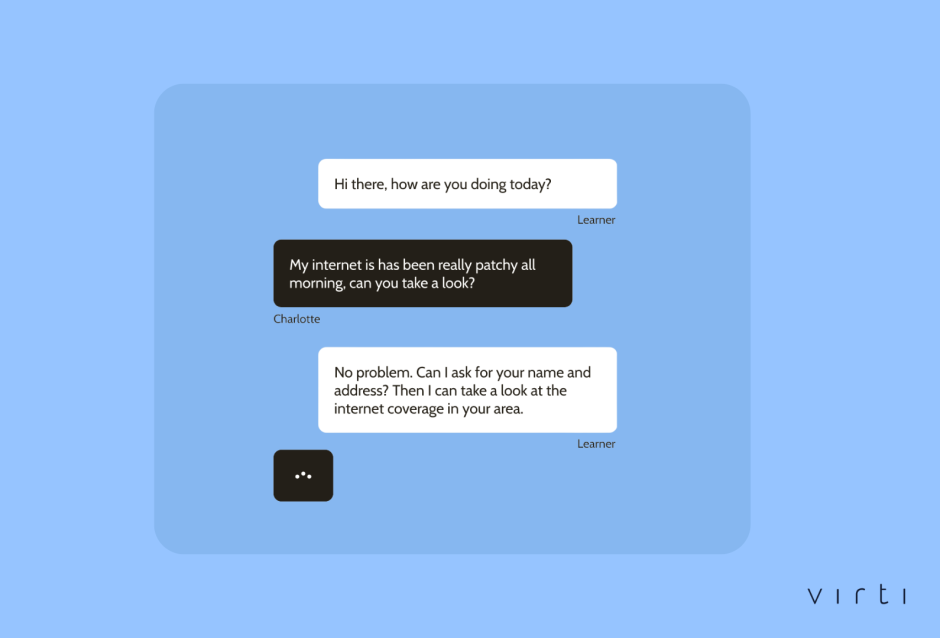
Working with the AI tech company Virti, Chang has deployed AI-powered virtual patients across multiple hospital systems, creating what he calls “quality control for communication skills and empathy” something that was “impossible to control in the past thousand years.”
The results are striking:
- Top Hospitals: full adoption across nursing departments
- Multiple hospital systems: Daily demonstrations averaging 2-3 per day across Taiwan’s healthcare network
- Measurable outcomes: For the first time, hospitals can quantify empathy levels and provide targeted improvement plans
Beyond Training: Cultural Transformation
But this isn’t just about individual skill development. Chang has orchestrated something more ambitious: organizational cultural change.
At one hospital, instead of supervisors spending countless hours mediating conflicts between senior and junior nurses, the solution became systematic: “Ask them to do the virtual human training until they reach 80%, and they need to do a reflection.”
The approach transforms healthcare delivery from reactive crisis management to proactive skill building. As Chang puts it: “We turned the ‘nice to have’ into ‘must have.'”

Virti’s AI-powered avatars used in training nurses at Central Taiwan University of Science and Technology
The Ripple Effect
The program’s expansion tells the story of genuine transformation:
- Started in teaching departments
- Expanded to nursing departments
- Now includes social workers and quality control departments
- Creating “total cultural change for organizational change”
One hospital supervisor noted that after virtual human training, when nurses encounter difficult patients, they think: “Oh, this is virtual human scenario 69. I understand how to handle this. It’s not abnormal, I know how to handle it.”
The Global Implications
While similar photo-based virtual patient programs exist in countries, Chang points to a crucial differentiator: “They don’t know how to analyze learning behaviors, learning scores, and the AI system’s power to analyze performance based on customized criteria.”
This isn’t just training it’s the first scalable solution for healthcare empathy at an organizational level.
What This Means for Healthcare’s Future
Chang’s work in Taiwan represents a fundamental shift in how we think about healthcare quality. The traditional focus on clinical competency is expanding to include measurable emotional intelligence and communication skills.
The four-step promise is ambitious but achievable: “One minute to create virtual humans, 10 minutes to improve conversation skills, lower stress, and increase nurse retention.”
For an industry facing global staffing shortages and burnout crises, this approach offers something unprecedented: the ability to scale compassionate care without scaling human resources.

Lewis Chang, Head of Medical VR at HTC VIVE with hospital administrators at Tri-Service General Hospital
The Bottom Line
What started as a response to isolated incidents of patient aggression has evolved into a systematic approach to cultural transformation in healthcare. By making empathy measurable and trainable, Taiwan’s hospitals are pioneering a new standard for patient care quality.
The question isn’t whether this approach will spread globally—it’s how quickly healthcare systems worldwide will recognize that the future of medical training isn’t just about what clinicians know, but how compassionately they apply that knowledge.

Nursing Communication Resilience Training at Mackay Memorial Hospital
Ready to explore how virtual human training could transform your organization’s approach to communication and empathy?

This article draws on insights from interviews with Lewis Chang, Head of Medical VR at HTC VIVE; Alex Prodromou, Senior Director of Accounts at Virti; and Kurt Kratchman, CEO of Virti.