
Upskilling
9 min read
Traditional training methods often struggle to keep learners engaged and equip them with real-world skills. To address this, immersive learning experiences have become a game-changer, allowing learners to actively participate in realistic situations that build confidence, critical thinking, and decision-making abilities.
Fact: Scenario-based learning can improve knowledge retention rates by up to 35% compared to traditional learning methods, as it engages learners in realistic, relevant scenarios that are directly applicable to their work.
By integrating storytelling and real-world challenges, this approach makes learning more interactive and memorable.
Let’s dive into how Virti’s cutting-edge platform is revolutionizing training across four key areas.
Jump to:
- What is scenario based learning?
- Key Principles of Effective Scenario-Based Learning
- Sales Training + examples
- Leadership Training + examples
- Health and Safety Training + examples
- Healthcare Training + examples
What is Scenario-Based Learning?
Scenario-Based Learning is an interactive training approach that immerses learners in realistic, problem-solving situations. Instead of passively consuming information, learners engage in decision-making within a structured scenario that mimics real-world challenges.
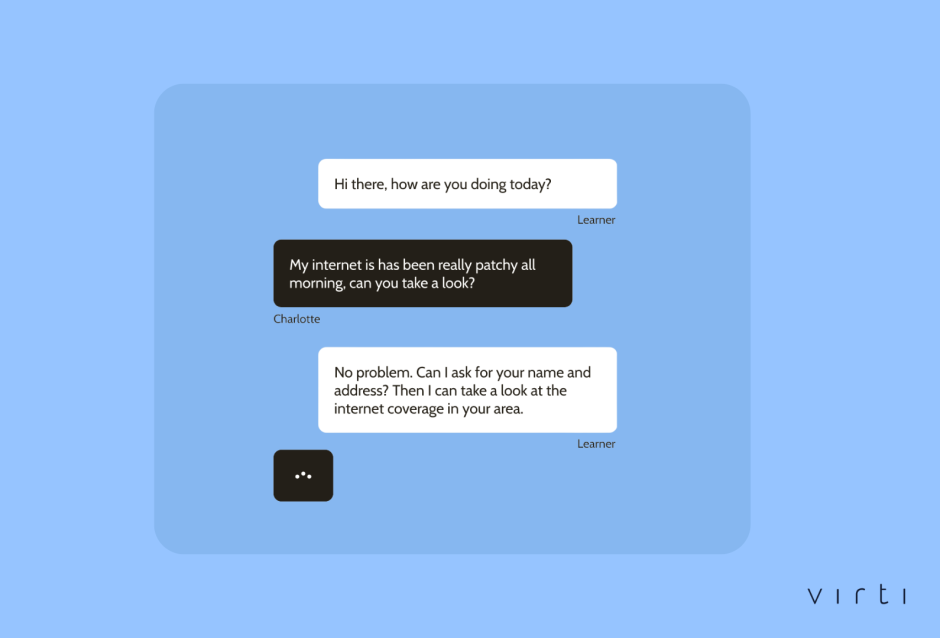
Platforms like Virti take scenario-based learning to the next level by integrating Artificial Intelligence (AI), interactive video, and real-time role-play, making training even more engaging and scalable.
Did you know: Experiential learning sees knowledge retention rates as high as 90%.
Key Principles of Effective Scenario-Based Learning
So whats a makes a ‘good scenario’? Effective scenario-based learning hinges on several key principles:
- It requires a thorough understanding of the learners and their specific needs. This involves identifying the skills and knowledge gaps that the training aims to address and designing scenarios that are both relevant and engaging.
- The scenarios should be crafted to promote critical thinking, transferable skills and problem-solving skills. This can be achieved by creating real life situations and open-ended scenarios that challenge learners to think critically and make informed decisions.
- Providing immediate feedback and opportunities for reflection is crucial. This active approach helps learners to pinpoint areas for improvement and fosters a deeper understanding of the subject matter, enhancing their overall learning experience.
How to write scenarios for training
Creating engaging scenarios is crucial for the success of scenario-based learning, and platforms like Virti make this process seamless. A well-designed scenario should be immersive, relevant, realistic and challenging, to capture real-world situations that learners can relate to. With Virti, you can let AI do the work with AI-driven role-play scenarios that simulate real-life situations, providing learners with hands-on, immersive experiences. The platform also supports the integration of 360-degree interactive videos and simulations, enhanced with hotspots and branching scenarios to maximize engagement and retention.
Practical Tips for Effective Scenario Design
Let’s expand a little more on what it looks like to create scenarios that drive true learning and long-term change:
- Start with Realism: Ground your scenarios in authentic workplace challenges that your learners actually face. Use details, dilemmas, and characters that mirror real life.
- Make It Challenging: Present problems with no obvious right answer. Encourage critical thinking and allow learners to explore consequences through their choices.
- Boost Engagement: Bring your scenarios to life with storytelling techniques, set the scene, introduce compelling characters, and use tension or conflict to draw learners in.
- Support Reflection: Build in opportunities for learners to receive immediate feedback, review their decisions, and reflect on alternative approaches.
- Iterate and Improve: Use data and learner feedback to refine scenarios over time, ensuring they stay relevant and impactful.
By combining these design principles with Virti’s AI and immersive technology, you can create scenario-based learning that not only engages, but also transforms behavior and skills for the long haul.

4 examples of scenario-based training
1. Sales Training
Sales is about more than just selling, it’s about connecting with customers and building relationships. Scenario-based learning for sales training in Virti engage learners through simulated scenarios, where they interact with virtual AI clients, handle objections, and negotiate deals. This approach minimizes the learning curve for sales trainees, allowing them to reach a point of skill more quickly. By experiencing the sales process firsthand, trainees gain confidence, improve communication skills, and learn to adapt to different customer needs, ultimately boosting sales performance.
Examples of sales training scenarios include:
a. Dealing with a Difficult Negotiation
Scenario: A client wants a significant discount or additional perks before committing to a deal. The learner must negotiate while maintaining profitability and strengthening the relationship.
Why It’s Effective: This scenario teaches strategic negotiation, helping sales professionals balance customer satisfaction with business goals. AI feedback can highlight missed opportunities and suggest improvements.
b. Handling an Upset Customer and Turning It into a Win
Scenario: A frustrated customer calls to cancel after a poor experience. The learner must empathize, de-escalate the situation, and offer a resolution that rebuilds trust.
Why It’s Effective: This scenario teaches emotional intelligence, active listening, and problem-solving. AI analysis can evaluate tone, phrasing, and effectiveness, helping reps refine their approach to customer retention.
Others include:
Closing the Deal with a Hesitant Buyer
Code Calling

2. Leadership Training
Effective leadership is essential for driving organizational success and fostering employee growth. Scenario-based leadership training engages multiple cognitive processes such as reflection, analysis, and evaluation. It provides aspiring leaders with opportunities to navigate complex management challenges, such as team conflicts, strategic decision-making, and change management. By experiencing these scenarios in a simulated environment, future leaders develop the skills and confidence needed to inspire teams, drive innovation, and adapt to evolving business landscapes.
Examples of leadership training scenarios include:
a. Leading Through Change and Uncertainty
Scenario: A company is undergoing a major shift, such as a restructuring, merger, or new strategy. The learner must communicate the changes, address team concerns, and maintain morale.
Why It’s Effective: This scenario helps leaders develop resilience, empathy, and clear communication skills to navigate uncertainty while keeping teams engaged and motivated. AI feedback can assess tone, clarity, and effectiveness in managing resistance
b. Making a Tough Decision Under Pressure
Scenario: A leader must make a high-stakes decision with limited information, balancing business needs, team morale, and ethical considerations.
Why It’s Effective: This scenario helps leaders develop decisiveness, critical thinking, and confidence under pressure. AI-driven analysis can assess decision-making patterns and suggest ways to enhance strategic thinking.
Others include:
- Motivating a Disengaged Employee
- Handling a Conflict Between Team Members
- Giving Constructive Feedback

3. Health and Safety Training
In industries where safety is paramount, effective training for health and safety is vital. Utilizing an active learning strategy, scenario-based learning engages employees in safety training by enabling them to tackle safety scenarios—such as accidents or hazardous spills—in risk-free environments. Making critical decisions and implementing safety protocols in simulations cultivates expertise and confidence, ensuring workplace safety and compliance.
Examples of health and safety training scenarios include:
a. Responding to a Workplace Accident
Scenario: An employee has suffered an injury on-site. The learner must assess the situation, provide immediate assistance, and follow proper reporting procedures.
Why It’s Effective: This scenario helps reinforce emergency response protocols, ensuring quick and effective action in real-life incidents. AI-driven feedback can assess response time, communication clarity, and adherence to safety procedures.
b. Identifying and Reporting Workplace Hazards
Scenario: A worker notices a potential safety hazard, such as exposed wiring or a slippery floor. The learner must assess the risk and determine the appropriate steps to report or resolve the issue.
Why It’s Effective: This scenario strengthens hazard awareness and encourages a proactive safety culture. AI analysis can provide feedback on risk assessment skills and the effectiveness of communication in reporting dangers.
Others include:
- Dealing with a Non-Compliant Employee
- Handling a Medical Emergency
- Fire Emergency Evacuation
4. Healthcare Training
Healthcare professionals face challenging situations daily, requiring quick thinking and precise decision-making. Scenario-based learning in medical industries simulates medical emergencies, patient consultations, and ethical dilemmas, allowing trainees to apply theoretical knowledge in real-life scenarios. By practicing clinical skills and communication techniques in a safe environment, healthcare professionals enhance their preparedness, confidence, and ability to deliver quality patient care.
Examples of healthcare training scenarios include:
a. Communicating Difficult News to a Patient or Family
Scenario: A healthcare professional must inform a patient or their family about a serious diagnosis or unsuccessful treatment outcome with empathy and clarity.
Why It’s Effective: This scenario helps healthcare workers develop compassionate communication skills while managing patient emotions. AI role-play can assess tone, clarity, and emotional intelligence to improve bedside manner.
b. Communication During a Handoff
Scenario: A healthcare provider must hand over a patient to another team, ensuring all critical information is communicated accurately and efficiently.
Why It’s Effective: This scenario improves teamwork, reduces medical errors, and ensures continuity of care. AI simulations can evaluate clarity, completeness, and effectiveness of information transfer.
Others include:
- Preventing and Responding to Medication Errors
- Handling a High-Stress Emergency Situation
- Managing a Difficult or Non-Compliant Patient
Conclusion
Scenario-based learning is revolutionizing training across industries, from sales and leadership to healthcare and workplace safety. By immersing learners in realistic, decision-driven scenarios, this approach enhances critical thinking, problem-solving, and knowledge retention while fostering empathy and practical skills.
Platforms like Virti deliver scenario-based learning to the next level by enabling AI-driven role-play, interactive video simulations, and real-time feedback. With Virti, organizations can create scalable, engaging, and impactful training programs that prepare learners to excel in their roles. Whether for soft skills development, customer service training, or professional upskilling, scenario-based learning powered by Virti ensures a more effective and lasting learning experience.
Try it out yourself, start your 14-day free trial today.