
News
9 min read
Leadership training is everywhere but how much of it actually sticks? All too often, managers attend a one-off workshop or skim through a presentation, only to fall back into old habits by Monday morning.
The difference between short-term exposure and long-term impact comes down to one thing: practice
Leadership training scenarios often expose participants to challenging situations that test and build their leadership skills, preparing them to handle real-world crises, conflicts, and high-pressure moments.
Well-designed, realistic scenarios give leaders the chance to rehearse high-stakes conversations, test their judgment, and build confidence in a safe environment. These scenarios help identify key team members with the qualities found in good leaders and great leaders, such as empathy, motivation, and the ability to inspire others.
So, let’s break down why scenario-based learning works, what makes a great leadership training scenario, and how you can start designing your own whether you’re using traditional methods, AI-powered role-play, or immersive video.

Why Scenario-Based Learning Works in Leadership Development
Leadership isn’t just about knowing what to do, it’s about making the right call in real moments of pressure. Leadership development programs often skip this part. That’s why scenario-based learning is so effective. It transforms passive training into active decision-making, helping team leaders develop the judgment, confidence, and emotional intelligence they need in the real world, while preparing them to face challenges that arise in leadership roles.
Here’s why it works:
- It builds real-world confidence: Practicing tough conversations, like giving feedback or navigating conflict, makes leaders more comfortable when those situations actually arise.
- It turns theory into behaviour: Reading about communication skills is one thing. Role-playing a tense meeting with an upset team member is another. Scenarios help bridge that gap. They allow participants to step into a leadership role and experiment with different leadership styles, discovering which approaches work best in various situations.
- It creates emotional relevance: The most powerful learning happens when there’s tension, stakes, and a chance to get it wrong. Good scenarios tap into that.
- It supports reflection and repetition: The ability to try, fail, and retry, especially with AI training tools, means leaders can continuously improve in a safe environment.
Whether you’re training first-time managers or senior executives, scenario-based learning is one of the most effective ways to drive lasting leadership development.
What Makes a Great Leadership Training Scenario
Not all leadership training scenarios are created equal. The ones that actually drive behavior change and build confidence share a few key traits and it’s not just about being realistic. It’s about being relevant, repeatable, and reflective
Here’s what to include:
- A Realistic Workplace Context
The scenario should mirror actual situations your leaders face, whether that’s managing team dynamics, navigating organizational change, or handling performance conversations. Including specific examples from your organization can increase relevance and help participants connect the scenario to their real-world experiences. - Clear Learning Objectives
Every scenario should focus on a specific leadership competency, like team building, conflict resolution, decision-making, or giving feedback. Define what “success” looks like before building the dialogue. - Emotional Stakes
Great scenarios challenge the learner with tension: a frustrated colleague, a missed deadline, a difficult team member. Scenarios can also include ethical dilemmas to challenge moral judgment and decision-making under pressure. Without stakes, the conversation won’t feel real and it won’t stick. - Multiple Decision Points
Real leadership isn’t linear. Scenarios should include branching paths or consequences based on the choices a learner makes. This keeps the experience dynamic and encourages reflection. Multiple decision points also help participants practice making informed decisions in complex situations, especially when facing ethical dilemmas or ambiguous outcomes. - Built-In Feedback and Retry Opportunities
Whether it’s a live debrief or automated AI feedback, learners need to understand what worked, what didn’t, and how to improve. Repetition helps reinforce the skill.
Designing effective scenarios takes time but when done right, they become one of the most powerful tools in your leadership training toolkit.
Examples of Effective Leadership Training Scenarios
Strong leadership training scenarios put learners in the driver’s seat of professional development forcing them to make decisions, adapt to challenges, and reflect on their approach. Here are four practical examples that can be adapted to suit your organization’s needs:
1. Delivering Constructive Feedback
Scenario: One of your direct reports has been missing deadlines and their work quality is slipping. You need to address the issue through effective feedback delivery in a one on one meeting, without demotivating them.
Learning Focus:
- Communicating clearly and respectfully
- Addressing performance issues head-on
- Address team concerns
- Effective feedback delivery in one on one meetings
Why It Works: It mirrors one of the most common leadership challenges and helps build emotional intelligence and clarity under pressure.
2. Navigating Team Conflict
Scenario: Two high-performing employees are in conflict, and it’s affecting team morale. In this scenario, the conflict resolution participants are the two team members whose disagreement is impacting other members of the team. You’re tasked with facilitating a resolution.
Learning Focus:
- Active listening
- Conflict mediation
- Crisis management
- Fostering better understanding among all involved
Why It Works: This scenario teaches leaders to handle tension constructively and preserve relationships under strain.
3. Leading Through Change
Scenario: You need to inform your team about a significant process change that may impact workloads and priorities. Reactions are mixed.
Learning Focus:
- Communicating change clearly and empathetically
- Managing resistance
- Reinforcing vision and motivation
- Strategic thinking
- Leading teams to change effectively through open communication
Why It Works: Change is constant. Leaders must learn to navigate uncertainty and bring others along with confidence and clarity. This scenario is often included in leadership training programs to build change management skills.
4. Delegating Effectively
Scenario: You’ve been given a new project and, as the team leader, need to delegate tasks across your team — specifically to individual team members, including two team members who may have differing levels of willingness, with one team member resistant to taking on more.
Learning Focus:
- Trust-building
- Assessing team strengths
- Coaching for accountability
- Understanding the strengths and motivations of individual team members
Why It Works: Delegation is a critical leadership skill, but it’s often avoided or done poorly. This scenario reinforces both planning and people skills.
How AI Role-Play Makes Scenarios Stick
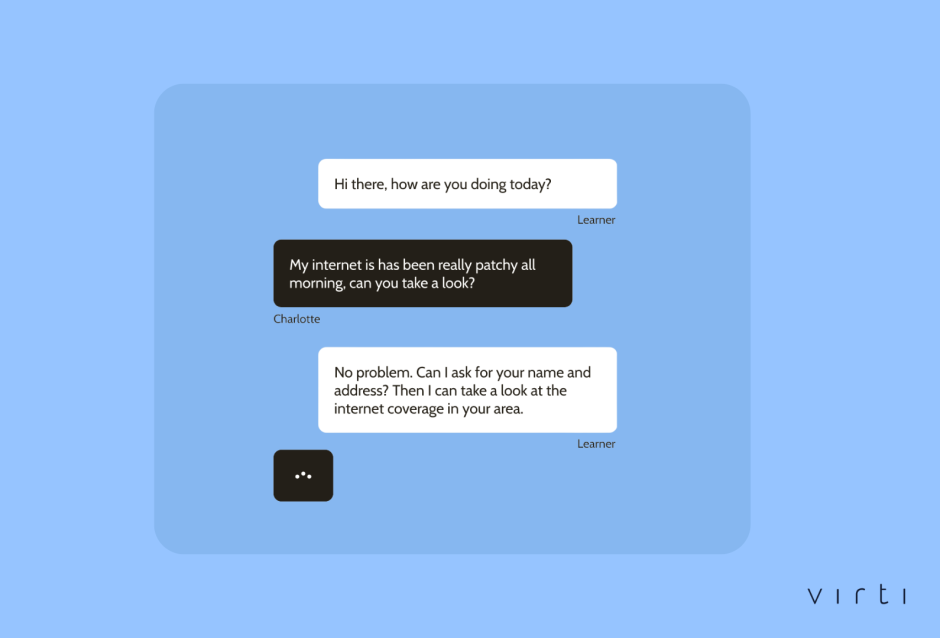
Scenario-based learning becomes even more powerful when paired with AI. Instead of relying on scheduled role-plays or other team members, AI role-play platforms, like Virti, allow leaders to train anytime, with consistent quality and actionable feedback.
Here’s how AI elevates leadership training scenarios:
- Realistic Virtual Humans: AI-powered avatars simulate real workplace interactions, responding with natural tone, facial expressions, and adaptive dialogue. Learners get a realistic experience without needing another person present.
- Practice On-Demand: Leaders can engage in scenarios whenever it suits their schedule whether it’s before a big meeting or during a lunch break. This makes training more flexible and habitual.
- Feedback That Goes Beyond “Good Job”: AI analyzes speech, pacing, emotional tone, filler words, and more giving precise, unbiased feedback. Learners instantly see where they nailed it and where to improve. AI can also instruct participants on specific ways to enhance their performance and encourage participants to try new approaches for better results.
- Safe Space to Learn by Doing: Leaders can make mistakes privately and retry as often as needed. This reduces performance anxiety and increases willingness to experiment with new communication styles. AI can prompt users to dive deeper into their reasoning and decision-making, fostering greater self-awareness.
- Scalable and customizable: Organizations can create tailored leadership training scenarios that align with company values, culture, and real-world challenges then deploy them across teams globally.
Best Practices for Designing Your Own Leadership Training Scenarios
Whether you’re using a whiteboard, a slide deck, or an AI-powered platform like Virti, the principles of great scenario design are the same. Identifying the skills needed and critical skills for effective leadership is essential. Here’s how to build training scenarios that actually drive behavior change:
1. Start with the skill, not the story
Before writing a word of dialogue, define what leadership skill you’re targeting. Is it giving feedback? Leading under pressure? Coaching others? Clear focus leads to meaningful outcomes.
2. Make it real (but not overcomplicated)
Use situations your leaders are likely to face. The scenario should feel familiar, not theatrical. Keep it concise and focused on one core challenge.
3. Add tension and choice
Leadership is about navigating grey areas. Include multiple paths or decision points that reveal the impact of different approaches. This encourages reflection and critical thinking.
4. Build in feedback and repetition
The learning happens after the scenario. Offer feedback based on performance, whether that’s AI-generated insights, manager coaching, or peer discussion. Then, give the learner a chance to try again.
5. Evolve with your team
Keep scenarios current by updating them with real challenges, new policies, or evolving leadership frameworks. Involve the whole team in scenario updates to foster a high performing team and encourage collaborative improvement.
You made it to the end!
You’re now in the right place to get started with improving the way your leaders are trained and provide them with training that sticks! Designing the right scenario is just the beginning and with the right tools in your pocket you can build a team of confident, dependable leaders.